ML-01-01 What is a Computer
What is a Computer
Computers have been around for a long time. Initially introduced in the 1930’s, computers became commercially available from about the 1950’s as large systems aimed at large corporations, computers evolved over time to be consumer products as personal computers.
In this section we start by considering what a computer is and why we use and need them. We then discuss some key technology developments that have resulted in the emergence of Smartphones and what we can expect going forward.
“A computer is a machine or device that performs processes, calculations and operations based on instructions provided by a software or hardware program. It is designed to execute applications and provides a variety of solutions by combining integrated hardware and software components.” ( https://www.techopedia.com/definition/4607/computer accessed 2019/03/25)
The statement above conceals a lot of technology, but it does highlight the main purpose of computers. Notably, people use computers to run applications that are useful and help get things done.
Basic Technology Concepts – Computers
There are a few important concepts to understand:
Computers have electronic components (System Hardware):
- A processor for executing instructions (more on this in a minute)
- Memory and other Storage for storing data and program instructions
- Input devices like a keyboard, computer mouse, touch screen, a camera
- Output devices like a screen or display, speakers, printer
Computers have programs that they run (Software Applications)
- Computers only do what they are told. Each computer processor has an instruction set that it can process. This enables it to load instructions from storage and memory, work with and manipulate data, process inputs and outputs etc.
- A program is a set of instructions that a computer can execute or process.
- Software developers write programs to get the computer to do something.
- Some programs are built into the computer and manage its operation and understand how to process inputs and outputs. This is called the computer’s Operating System. The operating system could be given commands by the computer user and told to load an execute programs as needed.
- Some programs do specific things for us like playing music, taking pictures, writing a document, sending an email. These type of programs are referred to as Applications and are aimed to do something useful for the computer user.

How have computers evolved over time
The ongoing development of technology components has resulted in a dramatic shift in terms of the design, development and use of computers.
There were principally two main streams of development for computers:
- Computers that had a specific purpose – Process control, managing a production line, water levels in dams, etc. Programs were very specific and integrated closely with the electronics of the system, developed to achieve a specific purpose in an industrial environment. In some cases these computers did not have an operating system, and the application interacted directly with the electronics of the system.
- Computers that had a general purpose – The computer was developed as a system that could be adapted to meet current and yet unimagined needs. The computer manufacture developed a program referred to as the operating system in order to make it easy for software developer to write applications that could be used on their computer. Software developer could exploit this potential independently of the computer hardware and operating system vendors. Applications that a specific business or user chose, could be loaded onto the computer – Accounting applications, Database applications etc. Programs were varied, not normally dependent on specific electronic features.
Initially computers were very large, consumed large amounts of power, and required specialists to program and operate them. These computers were called mainframes and were very expensive, affordable only by large government and private enterprises.
There were a few key areas of technology development:
- Components became more reliable (Improved Materials and Manufacturing techniques)
- Components became smaller (Scientific Advances and Manufacturing Capability)
- Components became cheaper to produce (Economies of Scale)
- Computers became easier to use (Improved User Interfaces)
- Application Development has become easier (Tools for Developers, Shared Code Libraries)
As a result, mainframes became mini-computers, small enough and affordable enough for small to medium businesses to buy and use. As they became smaller we saw personal computers, tablets and Smartphones. In future we will see computers that we wear, smart watches, smart caps, smart glasses etc. The cost of computing power, storage capacity, and network capacity continues to decline making services more accessible and affordable.
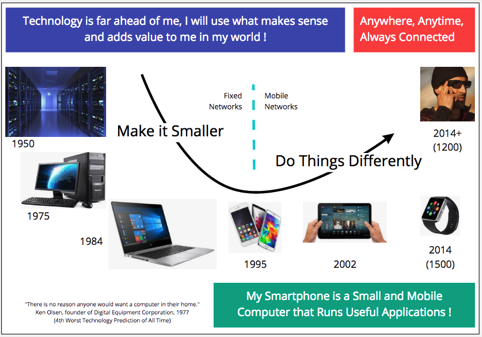
In about the mid 1970s, we saw the emergence of the concept of a personal computer. At the time, there was limited understanding of why anyone would want a computer at home for their personal use.
While technology has developed significantly, we, as users, determine the pace of adoption based on when we see the function and features being useful to us. Some users are early adopters of technology. Most of us are part of the majority, or sometimes late adopters.
Where we are in terms of technology use is a result of our perception of the value of the technology to us personally, our level of affordability, our own competency levels, and our socio-economic circumstances.
What we do know, is that many millions of users are benefitting from the use of technology in their daily lives. The question we must ask ourselves is whether we will benefit by using technology as it is today, and in the future. We need to ensure our understanding and skill is at the right level to realise the benefits. This means we must invest energy and time to learn how to use the technology if we want the benefits. If the perceived value of using the technology is high, we should do so.
Summary
A large, and increasing percentage of people have access to computers today, in the form of applications.
These computers have general purpose operating systems (Windows, OSX, Android and IOS) and intuitive user interfaces.
Software developers have developed millions of applications that are now available, either free or at affordable prices, from application stores (GooglePlay, Apple AppStore) or from developers’ websites.
Whatever we do, there are applications available for us to use on our smartphones to help us in our daily personal and work lives.
Learn, experiment, adopt and benefit! You have a lot to gain and little to lose.